
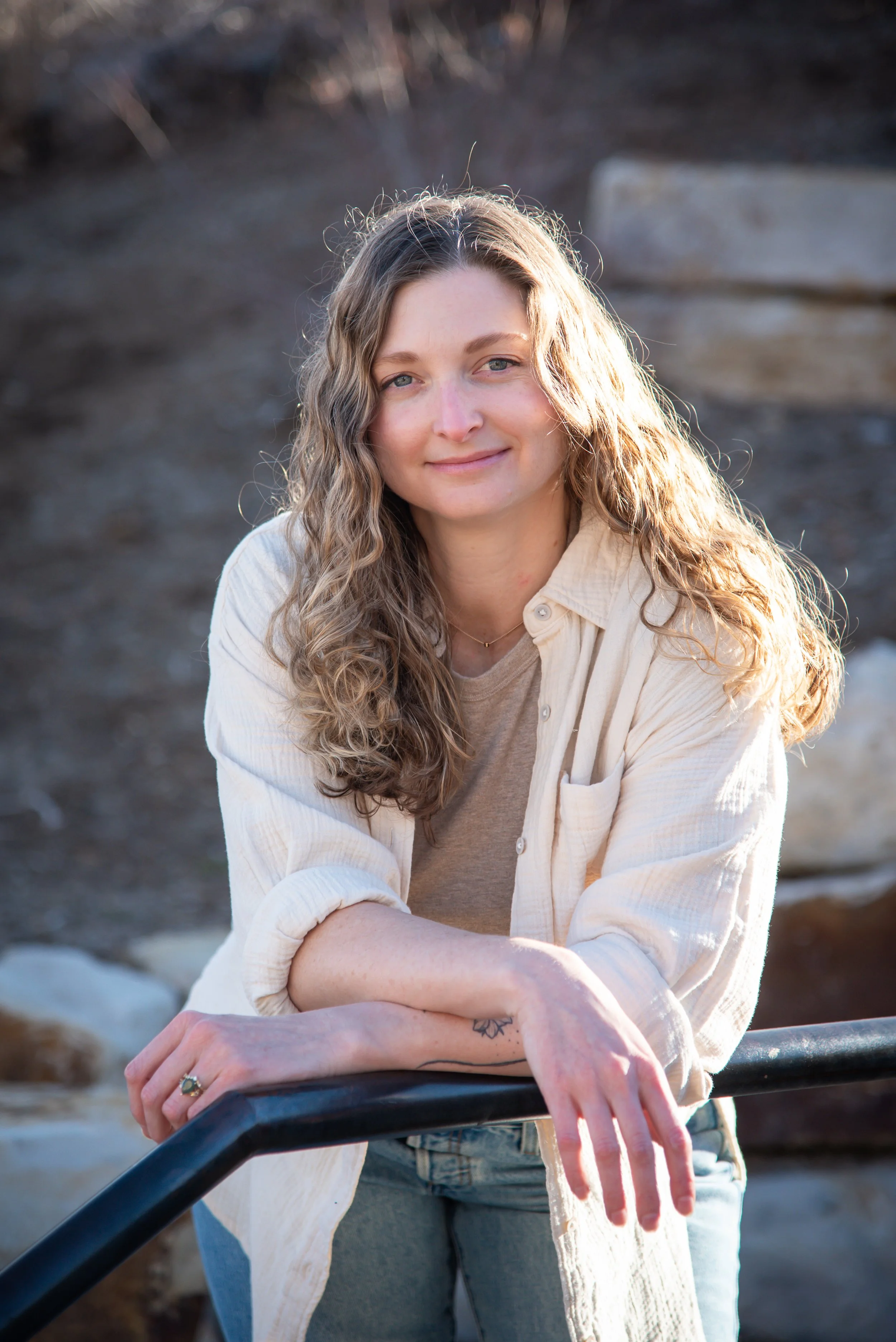
About Laura Vogel, LCSW
I know this way of living isn’t working for you anymore.
I’m a Castle Rock-based therapist offering online sessions in Colorado and California. I specialize in working with high-functioning anxious women who are at a threshold point in their lives - where the ways they’ve been coping, achieving, and holding things together no longer feel sustainable.
From the outside, your life may look like it’s working. But inside, you feel constant pressure: overthinking, pushing, analyzing, trying to get it right, and never quite being able to settle.
You’ve likely already tried to find ways to manage your stress better, practice self-care, and shift your mindset. These methods can start to feel like just another task on your to-do list, rather than something restorative or actually helpful.
There’s nothing wrong with those approaches. It just might not be enough because it is not addressing why your anxiety is there in the first place.
It is like putting a bandaid on a deep cut.
In our work together, we look underneath what is happening on the surface instead of trying to override the pressure and the patterns you want to change. I can help you understand how these patterns formed and what they have been trying to do for you, which allows for shifts to really start happening. This creates change that feels less like effort and more like something actually starting to loosen.
You might be wondering what changes when you’re no longer doing all of this alone.
You don’t have to perform insight here. You don’t have to “do therapy right.” When overthinking, self-criticism, or urgency show up, we don’t fight them; we get curious about them. Sessions with me tend to feel less like problem-solving and more like learning how to relate to yourself in a new way.
We don’t rush to solutions or push past the parts of you that feel stuck. We move at a pace that allows understanding, compassion and presence to come before change. That often means slowing down in places where you’re used to pushing through, fixing, or analyzing yourself. Slower is faster.
Many of my clients are surprised by how much shifts when they stop trying so hard to change.
Why I See Anxiety Differently
For a long time, I believed therapy was about fixing yourself.
Figuring out all the childhood wounds and connecting all the dots, in order to understand. I thought change would come through managing the symptoms, alleviating them, figuring out how to be more in control of them, let them go, not care anymore.
But that approach never felt quite right to me. It created more pressure, more self-monitoring, and more shame, and it didn’t lead to the kind of change I was actually looking for, either personally or professionally. It often led to stuckness and frustration, and I wonder if that feels familiar.
I found myself at a threshold where something had to change.
When I was introduced to Internal Family Systems (IFS or parts work), something shifted. I began to see that what I had always called “perfectionism” wasn’t just a personality trait. It was a part of me that had taken on the job of keeping me safe, capable, and worthy. Instead of trying to silence it or push past it, I started getting curious about it. What was it protecting? Why was it working so hard?
This is what I mean by going beyond surface-level work.
What we often label as overthinking, self-criticism, or burnout are not character flaws. They are protective patterns that developed for a reason. They helped you function and achieve, but they can also leave you feeling tense, disconnected, or always reaching for something just out of reach.
Real change doesn’t come from fighting those patterns harder. It comes from relating to them differently so something steadier in you has more space to lead.
Specializing in…
01
02
03
04
My Training & Education
-
Licensed Clinical Social Worker in Colorado and California
BA in Psychology with a minor in applied psychology from University of California - Santa Barbara
MSW from University of Southern California
-
Level 1 IFS Training from the IFS Institute
Retreats and Workshops with IFS (as I can’t get enough!) - find out more on my IFS page
IFS Consultation
Professional Skills 1 & 2 in EFT Tapping from the Association of Comprehensive Energy Psychology (ACEP)
Currently in the process of accreditation in EFT Tapping through ACEP
-
Member of Association of Energy Psychology
Continuing Education with the IFS Institute
Why do I keep mentioning the slow way home?
The Foundation of my Practice
The Slow Way Home came to me as I reflected on my own healing and the journeys of my clients. We live in a culture OBSESSED with urgency, productivity, and outcomes. Even therapy can start to feel like another thing to optimize.
This work is countercultural. Because this culture is not well. It asks you to slow down. To step off the hamster wheel of doing and achieving and managing. It may even (ahem… will) feel uncomfortable at first.
But the slow way home leads to something different: change that is sustainable. A way of living that isn’t driven by urgency or self-correction, but by steadiness and Self-trust.
If you’re curious about the slow way home, we may be a good fit. Let’s begin.
find the way back home to yourself.
—
find the way back home to yourself. —